I always learn from my students; sometimes the lesson is unexpected.
It started several years ago when I taught middle school in Colorado. There had been a tsunami in Southeast Asia and there was a lot of news coverage. I remember watching children on a beach on one of those islands. They were playing – actually, they were digging through piles of debris that had washed ashore after the tsunami devastated their island, looking for something to play with. It broke my heart.
The next day, I went to school and watched our students with their cell phones and iPods and I wondered how they would do if suddenly everything that they had was gone. Since it was close to Thanksgiving, I decided to turn this current event into a lesson. I talked about how our hands here in the US are so full – full of food, books, games, distractions… And I talked about how those children on the beach had nothing. Their hands were completely empty.
Of course, time moved on and now I’m teaching elementary school in Wisconsin. But the world is still filled with tragedies and incomprehensible loss. I sat in a meeting last week with a woman whose granddaughter lives in Florida. Due to the hurricane that recently impacted that region, that young girl is going to school in a high school and has missed a great deal of school because of the storm. Then of course, there are the fires in the west. Specifically, the fire in the small town of Paradise, California – a town we’ve been to, a place where people we know have made their home.
In my classroom, I watched as one of my students picked up a reading book and then changed his mind and grabbed another one instead, and then repeated that action three or four times. He had so much to choose from while children in Florida and in California have nothing.
So, I once again talked to my students about how their hands are full.
It’s often a hard concept for children to understand – the idea that they have so much when others have nothing. I tied it into the fact that we are almost to Thanksgiving.
I gave my students a piece of paper and asked them to draw around their hand. I asked that they enclose the hand completely. I then showed them a photo of an elementary school in Florida that was damaged during the hurricane. Afterward, we viewed a picture of the burned out skeleton of the elementary school in Paradise. We talked about how the students in those schools – and others impacted by similar tragedies – have nothing because it is all gone. We talked about how very much we have including library books, games, puzzles, text books, desks, playground equipment, a roof, and walls. Truly, our hands are full.
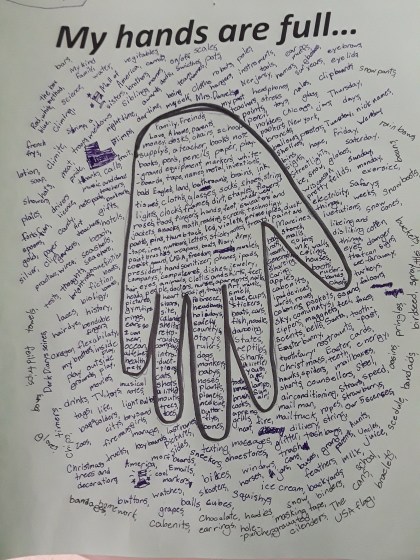
Students were then instructed to write things into the drawing of their hand – things that they have, things for which they are thankful. They kept it on their desk for two days. As they thought of something, they wrote it into their hand. The thought was simple: our hands are full – fill the picture of your hand with things that you have that others may not. It was intended to be an exercise in gratitude, an opportunity to realize how very rich we are in our country, the chance to recognize how much we have.
I completed mine and hung it up on our “Works of Art” bulletin board. The children continued to work on theirs. It took them two days to fill their hands and as they did, they hung theirs up as well. At the end of the last day to turn it in, we were down to two or three students and I reminded them that they needed to be finished. One little girl went to put hers up when I realized what I was seeing…
She had written very small – she always does – and not only did she fill her hand, but she filled the paper around her hand as well. Yes, she FILLED it. Many of the things are definitely fourth grade things, they are written from the perspective of a child. Even so, I was amazed – and I continue to be. SHE FILLED THE PAGE. Some of her listed items make me smile.
Still… She. Filled. The. Page.
When was the last time I was truly aware of the things that fill my hands?
When did I last give thanks for my glasses, or eagles, or land, or buckets, or eyebrows, or zippers? I’ll freely admit it, I’ve NEVER been thankful for spiders… ick. But there are a lot of things on her list that I COULD be and perhaps SHOULD be thankful for.
There is so much more in this world to be thankful for – so many more things to be aware of, to appreciate, to value.
A ten year old reminded me of that fact.
We live in a world that is filled with God’s hand and God’s touch. We need to realize that our hands are full. We need to show our gratitude.
I needed to be reminded; I need to be grateful.
 Laughing - Loving - Praying