

It’s the day after Good Friday and the day before Easter. Can you imagine what this day was like for the disciples and for Jesus’ followers?
Imagine that you are one of the disciples that Saturday. Yesterday was a terrible day for you and today isn’t much better. Yesterday, the man you loved and served and worked with died a cruel, painfully agonizing death on a cross.
This is not a quick or easy death. First, Jesus was arrested, tried in a kangaroo court where the outcome was clear in advance, He was beaten, forced to carry a heavy, wooden cross up a road, up a hill to a place where He dropped the cross onto the ground. His robe was removed and He was nailed to the cross He had just carried. Afterward, Roman guards stood the cross, using their strength, ropes and probably even boards to push it upright. Then, it dropped into a hole with a jarring thud.
Imagine the pain that would have occurred around the nails as the cross fell two or three feet or so into a narrow hole onto hard ground. It would have bounced as it settled into its place before the crowds. Jesus hung there attempting to breath.
He knew and understood what was happening. He had chosen this path. It was in His power to stop this horrible, painful, tragic event, yet He chose to remain in that spot, suspended between heaven and earth.
How would you have felt? How would I? Would we have run? Would we have given up? Would we have focused on the loss?
They were confused and hurting. They could not imagine how this “horrible, terrible, no good, very bad day” (Judith Viorst) could ever improve. In fact, looking with a human heart and a human eye, there was no possibility of the day improving. They were experiencing — in their hearts, their spirits, their emotions — a sense of loss, of pain, of grief, and the hurt was overwhelming.
As most of you know, this has been a season of loss for me. In August, my grandmother, my dear prayer partner and confidante went home to be with Jesus. In September, and amazing former student died in a tragic accident. Most recently, in February, my brother died.
I have discovered that there can literally be a physical reaction to loss. For days and days after each of those losses, it seemed as though I could never get warm. it was almost as if my body’s core temperature lowered and I sat and shivered, even as I worked. I simply could not get warm.
Perhaps the disciples, His followers, His friends had a similar reaction. Perhaps as the darkness fell over the earth, these men and women sensed a loss so profound that they may have felt chilled to the bone.
Yet, they had His promise — they did not understand it — but they had His promise that His death was not the end of the story.
I was in a fellow teacher’s classroom on Friday as she finished reading a classic novel to her class. The novel ended, the story was over, and still the students and I wanted more information. I wanted to know what happened next, I wanted to move beyond the ending and know what came next — but I could not know; the story was over.
The disciples and His followers knew that the story was NOT really over. They knew and believed that the man hanging on the cross was our bridge to His Father — our Heavenly Father. This wasn’t over yet.
They had hope. They could look above the waves that seemed to engulf them, that were trying to drown their faith and they could focus on Him and His words, His promises, and HIS CHARACTER. They could focus on Him. They could look above the waves and see Jesus.
Even though they were looking above the waves and seeing the possibilities and the hope — they did not understand. My friends, His death gave us a future. Through Christ’s death, we have life, because it did NOT end in that tomb on Friday night. It did not end in the that tomb as the guards watched over the stone on Saturday. It did not end in that tomb on Saturday night as the disciples tried to sleep, but were probably too numb to do so.
No, it did not end then because Sunday was on its way. And with Sunday, came the news that the stone had been moved, the tomb was empty and Jesus was living. Jesus was alive — Jesus IS alive.
We need to grasp and capture and claim and hold onto the idea that our Jesus lives. He is not another body in a tomb somewhere — He is living and breathing and He loves us — you, me…us. It is true that He could have stopped the agony He endured, but He chose not to do so. He chose to stay on the cross. He chose to die. He chose to be buried and to be raised from the dead.He chose to do what it took to save us.
His sacrifice is only meaningful if we choose to claim it for ourselves. His sacrifice has meaning to each one of us only as we accept it — accept the gift and ask Him into our heart. When we tell Him we have sinned, ask Him to forgive us, and rely on Him to help us live in a way that is pleasing to Him.
On Easter we celebrate an empty tomb, but more than that, we celebrate a risen Savior. Even so, there are times when I think our hope is too small. We define what we believe Gods wants to do by the circumstance in which we find ourselves. We define God’s power through our own human understanding. We define God — the maker of the universe, the creator of all things, the Savior — and we try to do so using man’s ideas. No wonder our hope is too small; we are trying to define the infinite with finite ideas. God is so much bigger than we can ever understand. Even though we struggle to understand it, we can experience it. We can experience a relationship with Him in our hearts where our emotions live, in our heads where our thoughts reside, and in our spirits where Jesus assures of His presence.
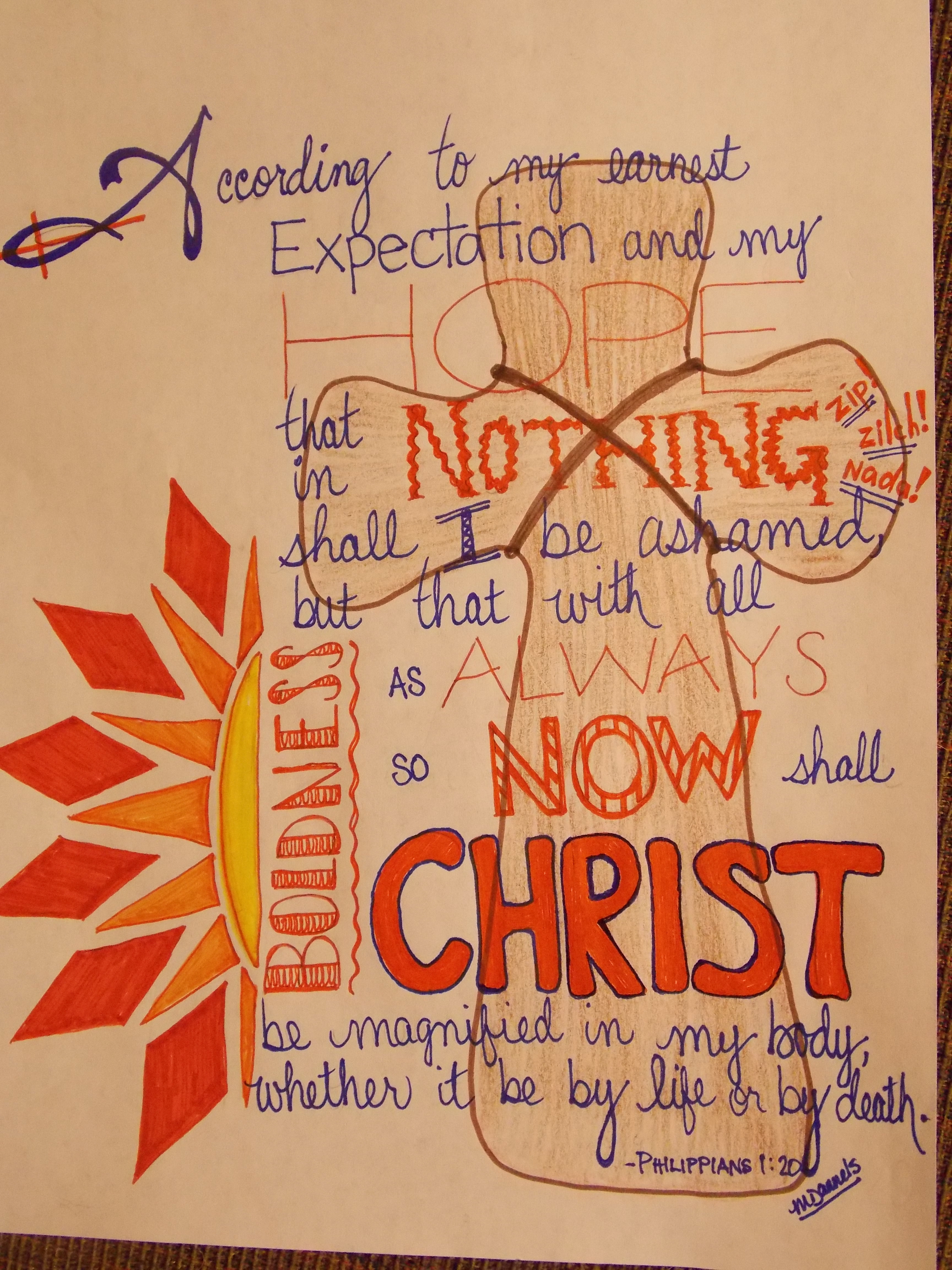
We need to hope in Jesus. We need to stop hoping too small.






 Laughing - Loving - Praying